


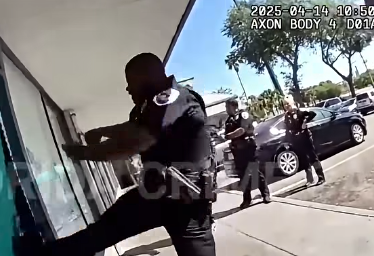
Creative narrative inspired by the visible body-camera footage, headline, and viewer comments shown in the supplied screenshot. The exact identities, charges, sequence of events, and outcome are not established by the screenshot alone. Some details below are presented as a narrative reconstruction rather than verified facts.
What begins as a confusing call at what appears to be a gas station quickly becomes a situation that leaves officers with more questions than answers.
The body-camera footage captures officers outside a commercial building in broad daylight. Several police vehicles are visible nearby. One officer approaches a door with urgency, while another appears to be positioned close behind.
The location looks ordinary.
Cars are parked nearby.
People are moving around outside.
Nothing about the scene immediately suggests that officers are about to encounter something extraordinary.
But according to the dramatic headline attached to the video, police are responding to a disturbing allegation involving a woman who was allegedly lured into a bathroom and seriously assaulted.
Then the comments begin raising an entirely different question.
Where exactly did this happen?
One viewer points out that the footage appears to come from a gas station rather than a hotel. Another says the clip may have been taken out of context and combined with a different story. Someone else questions why officers don’t simply break the window.
Those comments may seem like small details.
But together, they reveal something important:
The video being shown may only be one part of a much larger incident.
And that is where this story becomes much more mysterious.
The Scene Outside the Building
The first thing visible in the footage is the police response.
An officer moves toward the entrance with purpose.
The camera shakes as the officer approaches.
Other officers can be seen farther away.
Vehicles occupy the parking area.
The entire scene has the appearance of an emergency response rather than a routine conversation.
There is no dramatic music in real police footage.
No narrator explains what is happening.
The officers have to work with whatever information they received before arriving.
That information may have been incomplete.
It may have come from a frightened witness.
It may have involved conflicting statements.
Or it may have described something happening inside a bathroom where officers could not immediately see what was happening.
That creates a serious problem.
If someone may be in danger behind a locked door, officers cannot simply assume everything is fine.
At the same time, they need to determine what they can legally and safely do to enter.
Seconds matter.
A Door Becomes the Center of the Investigation
The officer reaches the door.
The entrance appears closed.
And suddenly the entire situation focuses on one question:
What is happening on the other side?
From the outside, nobody watching the footage can know exactly what the officer hears.
Maybe there are voices.
Maybe there is silence.
Maybe someone inside is refusing to respond.
Maybe officers have already received information suggesting that a person could be injured.
Whatever the circumstances, the officer’s movement toward the door suggests urgency.
The body-camera perspective makes the moment especially intense because the viewer is placed directly behind the officer.
There is no wide cinematic shot.
There is no explanation.
You see what the officer sees.
A door.
A building.
Other officers.
And the possibility that someone inside may need help.
Why Viewers Started Questioning the Location
The comments underneath the video introduce another layer to the story.
One viewer writes that the location was not a hotel but a gas station.
Another says they saw the beginning of the clip and remembers the scene being connected to a gas station bathroom.
That distinction matters.
The headline displayed on the video describes an extremely dramatic scenario.
But if the original footage actually began at a gas station, viewers may be seeing only a later portion of an incident that started somewhere else within the property.
This is common with short-form videos.
A creator may take a longer body-camera recording, select the most dramatic portion, add a headline, and present it as a short story.
The result can be compelling.
But it can also leave out critical context.
What happened before the officer reached the door?
Who called police?
Who was inside?
What did the caller report?
Was the alleged victim already outside?
Did witnesses identify a suspect?
Was anyone detained before this moment?
Those questions are impossible to answer from the screenshot alone.
And that uncertainty is exactly what makes the footage so intriguing.
The Alleged Bathroom Encounter
According to the headline shown over the video, a man allegedly lured a woman into a bathroom before violently assaulting her.
That is an extremely serious allegation.
But it is important to separate the video’s headline from verified facts.
The screenshot itself does not establish that the alleged assault occurred exactly as described, nor does it identify the people involved or confirm any eventual criminal charges.
Still, if officers had received a report of such an incident, the urgency of the response would make sense.
A bathroom is a confined space.
There may be only one entrance.
A person inside may have limited ability to escape.
And officers approaching from outside may have no clear view of what is happening.
That creates a difficult tactical situation.
Police need to determine whether someone inside is injured.
They need to determine whether a suspect is still present.
And they need to decide whether immediate entry is necessary.
The Question of the Window
Several comments focus on the building’s windows.
One viewer asks why officers didn’t simply break the glass.
Another jokingly suggests the windows may be bulletproof.
That discussion highlights something viewers often don’t consider when watching police footage:
Breaking a window is not always as simple as it looks.
A window may be reinforced.
It may be difficult to reach.
It may lead to an unsafe area.
There may be another way into the room.
Officers also have to consider what is waiting on the other side.
If they believe a dangerous person could be inside, smashing glass without knowing what lies beyond it may create additional risks.
So the officer approaches the entrance instead.
The camera moves closer.
The tension increases.
The Officer Makes a Decision
The officer suddenly pushes forward.
The movement is forceful.
The goal appears to be gaining access to the building.
At this point, the viewer can see several officers positioned outside.
That suggests this isn’t an isolated decision being made without support.
Other officers are nearby.
They can react if something goes wrong.
The camera captures the moment with the rawness typical of body-camera footage.
There is no second take.
There is no opportunity to reset.
Whatever happens next happens in real time.
And if someone really is trapped or injured inside, every second spent outside the door matters.
What Could Officers Have Been Told Before Arriving?
This is one of the biggest unanswered questions.
The body-camera footage begins after the situation is already developing.
Officers may have received information that isn’t visible in the clip.
Perhaps someone called emergency services.
Perhaps a witness saw a man enter the bathroom with a woman.
Perhaps the woman later emerged and reported an assault.
Perhaps employees inside the business heard something unusual.
Or perhaps the situation involved an entirely different emergency and the video headline dramatically reframed it.
Without the complete recording or official report, viewers simply cannot know.
That is why the comments underneath the video are so revealing.
Different viewers appear to have seen different parts of the footage.
Some recognize the location.
Others focus on the alleged assault.
Others question how the officers could enter.
And some appear confused about whether the video is even showing the beginning of the story.
A Story Hidden Behind a Short Clip
The internet rewards short, dramatic videos.
The more shocking the headline, the more likely people are to stop scrolling.
A phrase like:
“Man Lures Woman Into Bathroom & Rips Her Teeth Out”
immediately creates curiosity.
People want to know what happened.
Was the victim rescued?
Was the suspect arrested?
Why would anyone do something like that?
How did police discover the situation?
But dramatic headlines can also remove important context.
The viewer sees the most shocking claim before seeing the evidence.
That’s why a responsible retelling should treat the headline as an allegation rather than a proven fact.
The footage itself shows officers responding to a location and attempting to access an entrance.
The rest requires additional evidence.
Inside the Building
Imagine the scene from the perspective of the person waiting inside.
The sounds outside become louder.
Footsteps approach.
Voices can be heard.
Police are now at the door.
If someone inside is injured, they may be hoping help has finally arrived.
If a suspect is inside, the situation may be changing rapidly.
If witnesses are nearby, they may be watching the officers.
Nobody knows exactly what will happen when that door opens.
And that uncertainty creates the central tension of the footage.
The officers don’t have the luxury of knowing the ending.
They have to discover it.
The Possibility of a Victim in Need
When officers receive information suggesting someone may have been assaulted, their first priority is determining whether anyone needs immediate medical attention.
A person who has suffered a serious injury may require paramedics.
The location may need to be secured.
Other people may need to be separated.
A suspect may need to be detained.
Witnesses may need to remain available.
All of that can happen within minutes.
This is why police responses can sometimes look chaotic from the outside.
Several officers may move in different directions.
One may secure an entrance.
Another may speak to witnesses.
Another may look for the reported victim.
Someone else may begin controlling the surrounding area.
The body-camera footage captures only one perspective, but the larger operation can involve many moving parts.
The Mystery Deepens
One of the most interesting aspects of this particular video is that the comments don’t completely agree with the headline.
One viewer explicitly says the location was a gas station.
Another questions whether the video suddenly jumps into a different story.
Another asks why officers didn’t break the glass.
These aren’t minor observations.
They suggest that the footage may have been edited.
Perhaps an earlier portion showed how the emergency began.
Perhaps the bathroom was located inside the gas station.
Perhaps the creator combined multiple clips.
Or perhaps viewers are simply interpreting the footage differently.
Without the complete source material, we cannot know.
But that uncertainty creates a much more interesting story than simply repeating the headline.
What Happened Before the Police Arrived?
This may be the most important unanswered question.
The police did not appear at the location randomly.
Something happened before the body camera began capturing the scene.
Someone made a call.
Someone reported something.
Someone became concerned.
And that information caused officers to respond.
The original caller could potentially hold the key to the entire story.
What did they see?
What did they hear?
Did they know the people involved?
Did they see someone enter the bathroom?
Did they see someone leave?
Did the alleged victim ask for help?
Did an employee discover something unusual?
These details could completely change the interpretation of the footage.
The Parking Lot Becomes Part of the Story
The background of the footage is also important.
Several vehicles are visible.
Multiple officers appear to be present.
The location looks like an active commercial area rather than a private residence.
That means there could have been witnesses.
Customers.
Employees.
Drivers.
People walking through the parking lot.
Potential witnesses can be extremely important in an investigation.
Someone may have noticed a vehicle.
Someone may have heard an argument.
Someone may have seen a person entering or leaving.
Security cameras could potentially provide additional information.
In a gas station environment, surveillance cameras are often positioned around entrances, parking areas, and fuel pumps.
If an investigation occurred there, those recordings could become crucial evidence.
The Door Opens
Eventually, the officers need to get inside.
The exact sequence after this point cannot be established from the screenshot.
But narratively, this is the moment everything changes.
Before the door opens, the officers are working from information.
Afterward, they can see for themselves.
The environment becomes evidence.
People become witnesses.
And the officers can begin determining what actually happened.
If someone is injured, medical help can begin.
If a suspect is present, officers can take appropriate action.
If the room is empty, the investigation changes again.
Every possibility leads somewhere different.
Why the Comments Matter
The comments under the video provide a fascinating second layer of information.
One commenter challenges the location.
Another questions the editing.
Another asks about the window.
Another jokes about whether the window is bulletproof.
These reactions show how viewers process body-camera footage.
People aren’t just watching.
They’re analyzing.
They’re looking for inconsistencies.
They’re comparing what they see with what the headline tells them.
And sometimes, the comments reveal details that the video itself doesn’t explain.
But comments should still be treated cautiously.
A viewer’s memory of the original clip isn’t necessarily official evidence.
Someone saying “I saw the beginning” doesn’t prove what happened.
It simply provides another perspective.
A Warning About Viral Crime Content
This is especially important when a video involves allegations of extreme violence.
Sensational headlines can make viewers immediately assume guilt.
But an allegation is not the same as a conviction.
A person shown in a police video may later be released.
Charges may change.
Cases can be dismissed.
Evidence may tell a different story.
And the original headline may exaggerate what actually occurred.
For that reason, the strongest storytelling approach is not to declare every claim as fact.
Instead, the story can focus on the unanswered questions:
Why were officers called?
What did they discover?
Who was inside the bathroom?
Why did police need to force access?
What happened before the body camera started?
Those questions create suspense without pretending the available footage proves more than it does.
The Moment of Truth
The officer reaches the entrance.
The camera is close.
Other officers remain nearby.
The environment is bright and ordinary, yet the situation feels anything but ordinary.
This is the strange contrast at the heart of the footage.
A gas station is normally a place people visit for a few minutes.
Buy fuel.
Grab a drink.
Use the restroom.
Get back in the car.
But on this particular day, according to the video’s presentation, a routine stop may have turned into an emergency police investigation.
And somewhere inside that building is the answer.
What Officers May Have Been Looking For
If police believed a person had been assaulted, they would need to locate the alleged victim.
They would also need to determine whether the suspect was still present.
That means checking the immediate area.
Checking exits.
Speaking with witnesses.
Securing potential evidence.
And determining whether anyone else is at risk.
The situation could develop rapidly.
An officer who entered expecting to find one person might discover another.
A witness might provide new information.
A suspect might attempt to leave.
Or the alleged victim might already have been moved somewhere else.
That’s why the first few minutes of a response can be so important.
The Story Behind the Headline
The phrase “rips her teeth out” is so extreme that it dominates the viewer’s attention.
But the body-camera screenshot itself does not show such an act.
What it shows is an officer moving toward a doorway at a location where something serious appears to have happened.
That distinction matters.
The headline gives viewers a conclusion.
The footage gives viewers a question.
A responsible story should preserve that difference.
Perhaps the complete footage contains evidence supporting the allegation.
Perhaps the headline is exaggerated.
Perhaps the clip is part of a much longer case.
Perhaps the comments are referring to an earlier section that explains everything.
At this stage, the only honest conclusion is that there is more context behind the short clip than the screenshot reveals.
The Investigation Doesn’t End When Police Enter
Even after officers gain access, the hardest work may still be ahead.
Investigators would need to reconstruct the timeline.
What time did everyone arrive?
Who was there first?
Who entered the bathroom?
Who left?
What happened between those moments?
Were there witnesses?
Was there physical evidence?
Were there security recordings?
Did anyone seek medical treatment?
Were statements consistent?
These are the details that can transform a confusing incident into a documented case.
And that process can take far longer than the few seconds seen in a viral video.
A Story That Begins With One Door
Ultimately, the most powerful image in this footage isn’t necessarily the headline.
It is the officer approaching the door.
Because a closed door represents everything the officers don’t yet know.
Behind it could be a victim.
A suspect.
A witness.
An empty room.
Or evidence that changes the entire investigation.
The officers don’t know until they get inside.
And neither does the viewer.
That’s what makes body-camera footage so compelling.
The audience experiences the uncertainty at almost the same time as the officers.
Final Thoughts
The video presents an extraordinary claim involving an alleged assault inside a bathroom.
But the visible footage provides only part of the story.
The comments suggest the location may have been a gas station rather than a hotel, and several viewers appear to believe the clip begins in the middle of a larger incident.
Those observations raise even more questions.
What happened before the police arrived?
Who called them?
Why did officers need to force their way inside?
Who was actually inside the bathroom?
Was someone injured?
Was a suspect still present?
And what did investigators discover once they entered?
The answers cannot be established from the screenshot alone.
But one thing is clear:
The officers believed there was enough reason to act quickly.
A normal commercial location had suddenly become the center of a serious police response.
The parking lot was filled with vehicles.
Officers moved toward the entrance.
The camera followed.
And behind one ordinary-looking door was the information everyone was waiting to discover.
The most dramatic part of the story may not be what happened inside that bathroom.
It may be what happened before police arrived — the sequence of events that turned an ordinary stop at a gas station into an emergency response.
Because every body-camera clip begins somewhere.
And this one appears to begin after the story has already started.