


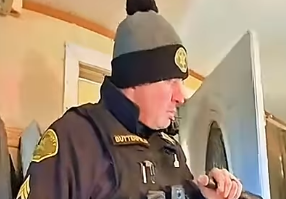
Creative long-form story inspired by the screenshot and visible comments. The full video, the people’s identities, and the actual outcome have not been verified, so the narrative below is an imaginative reconstruction rather than a factual report.
Introduction: When Someone Looks Like an Officer, Who Should You Believe?
Imagine opening your front door and finding someone standing nearby dressed in what appears to be police equipment. The person looks prepared, speaks with confidence, and seems determined to make their presence known. At first glance, the situation might appear ordinary. After all, police officers sometimes need to visit homes to investigate complaints, ask questions, or follow up on incidents.
But what happens when something about the encounter feels wrong?
That question lies at the center of the video titled “Fake Cop Gets Caught in Full Police Gear.” The footage appears to show a tense interaction inside a home, where a woman confronts someone and says, “I said stop.” Her words suggest that the encounter has become uncomfortable, although the screenshot alone does not establish exactly what happened before that moment or whether the person being challenged was impersonating an officer.
The comments reveal another layer of curiosity. Viewers question why someone would carry equipment such as a baton or a Taser, joke about the possibility of someone wearing police gear without actually being a police officer, and ask why part of the footage appears blurred. Others recall incidents in which people reportedly entered police facilities or presented themselves as officers before their true status became clear.
Together, these reactions raise an important question: how can ordinary people distinguish legitimate authority from someone merely trying to look authoritative?
The most compelling way to understand this encounter is to look beyond the uniform-like clothing and equipment. The real issue is trust, verification, personal boundaries, and the consequences that can follow when someone claims authority they may not possess.
1. An Ordinary Home Becomes the Setting for an Unusual Encounter
The scene shown in the screenshot looks like a modest home. A television sits against one wall, kitchen cabinets and a refrigerator are visible farther inside, and everyday household objects fill the room. Nothing about the setting suggests a formal police station or a controlled law-enforcement environment.
Instead, the encounter takes place in a private living space.
That distinction matters. People generally expect to have control over who enters their homes and how visitors behave once they are inside. Even when a visitor has a legitimate reason to be there, a disagreement can develop if communication breaks down or one person feels pressured.
In the visible frame, a woman wearing a light-colored sleeveless top stands near the television and extends one arm outward. Her expression and posture suggest frustration or an attempt to make a point. The subtitle reads, “I said stop.”
Those three words create an immediate sense of conflict.
What was she asking the other person to stop doing? Was she objecting to an action, trying to end an argument, or responding to something that had happened earlier? The screenshot does not answer those questions. Nevertheless, the statement indicates that the interaction had reached a point where at least one person wanted a behavior to end.
In a tense encounter, a simple request can become a turning point. If the other person respects the boundary, the situation may calm down. If the request is ignored, frustration can grow, and each subsequent exchange may become more confrontational.
That is why the opening moments of any encounter are often so important. They establish whether the people involved are willing to listen, explain themselves, and give one another enough space to resolve the disagreement.
2. The Uniform Effect: Why Appearance Can Influence People
Police uniforms and equipment carry a powerful social meaning. Badges, duty belts, radios, and other recognizable items can signal that someone has training and legal authority. Many people respond to those signals before they have had an opportunity to verify the person’s identity.
This is understandable. In genuine emergencies, people often need to recognize an officer quickly. Uniforms can help members of the public identify the person who is supposed to provide assistance.
But the same visual signals can be misused.
Someone who dresses like an officer may hope that other people will comply with instructions without asking questions. A uniform-like outfit can create an impression of authority even when the person wearing it has not demonstrated that they possess any official status.
That is the central concern raised by the video’s headline.
If someone is falsely presenting themselves as a law-enforcement officer, the problem extends beyond a misleading outfit. Depending on the circumstances and local law, impersonation may involve deceptive claims, unauthorized actions, or attempts to gain access or cooperation that would not otherwise be granted.
However, clothing alone does not prove impersonation. Some legitimate officers work in specialized roles, and some people may own costume equipment or other law-enforcement-style accessories for reasons unrelated to criminal activity.
The important distinction is between looking like an officer and lawfully acting as one.
The first is about appearance. The second involves actual identity, authorization, and conduct.
In the situation depicted, viewers are encouraged by the headline to suspect that the person’s apparent police identity may not be genuine. Yet a responsible account must leave room for facts that the screenshot cannot establish. The person’s exact role, what they said about themselves, and whether any official credentials were examined remain unknown.
That uncertainty is not a minor detail. It is the difference between discussing a troubling allegation and declaring that someone committed a crime.
3. “I Said Stop”: The Moment Tension Becomes Visible
The woman’s statement is the clearest piece of dialogue available in the screenshot. It sounds direct and unmistakable: she wants something to stop.
In a fictional reconstruction of the encounter, this moment can serve as the point where an initially confusing interaction becomes openly confrontational.
Perhaps the woman believes the visitor is overstepping a boundary. Perhaps she is objecting to the way the conversation is unfolding. Perhaps the disagreement began before the camera captured the visible scene. There is not enough evidence to choose among those possibilities.
What can be said is that her words communicate resistance.
When two people disagree about authority, their interpretations of the same event can be dramatically different. One person may believe they are entitled to give instructions. The other may believe those instructions are unwelcome, unjustified, or beyond the speaker’s authority.
If neither side pauses to clarify the situation, the disagreement can become a contest over who will control the interaction.
This is where communication matters most.
A calm explanation can often accomplish more than a louder command. Asking who someone is, why they are present, and what they want can help establish the facts. Equally, a person who is challenged should be prepared to explain their actions rather than relying solely on their appearance or demanding unquestioning compliance.
The goal should be to reduce uncertainty before it becomes a safety problem.
In the scene shown, the woman’s outstretched arm creates a visual impression of confrontation. But a single frame cannot tell us whether she is attempting to stop someone from approaching, gesturing during an argument, or simply emphasizing her words.
The full sequence would be needed to determine what happened.
That limitation is worth remembering whenever a short clip is presented as proof of a dramatic accusation. A moment can be genuine while still leaving out essential context.
4. The Equipment That Captured Viewers’ Attention
Several comments focus on the equipment associated with the alleged impersonation. One viewer questions why someone would need both a Taser and a baton for a funeral procession. Another jokes that perhaps the person should simply pay the money required to become a legitimate officer.
These remarks are sarcastic, but they reveal the question viewers are trying to answer: why would someone appear to be carrying law-enforcement equipment in a situation where its purpose is unclear?
Equipment can influence how threatening or authoritative a person appears. A baton, an electronic control device, a radio, or a duty belt may cause bystanders to assume that the wearer has training and permission to use those items.
That assumption can have serious consequences.
If the person is a legitimate officer, equipment may be part of their authorized duties. If the person is not authorized to carry or use it, the circumstances may be very different. Laws governing these items vary by jurisdiction, and legality can depend on the specific device, the manner in which it is carried, and the conduct involved.
The presence of equipment does not, by itself, establish criminal intent. Nor does owning a piece of equipment automatically mean someone intends to use it against another person.
The more important questions are practical: Was the person authorized to carry it in that setting? Did they claim to have official powers? Did they threaten anyone? Did they use the equipment or attempt to use it? Was anyone placed at risk?
The comments cannot answer those questions. They show how the equipment became a focal point for speculation, humor, and concern.
For viewers, the broader lesson is that the appearance of specialized equipment should not replace verification. People should not have to guess whether a person claiming authority is genuine, particularly when the encounter takes place in a private home.
5. A Question of Identity and Verification
One of the most unsettling features of an alleged police-impersonation incident is the uncertainty surrounding identity.
In a legitimate encounter, an officer should be able to identify themselves in accordance with the procedures and requirements that apply to their role and jurisdiction. Depending on the circumstances, verification may involve official identification, agency information, dispatch confirmation, or another appropriate method.
The safest approach for members of the public is not to attempt to resolve every dispute through confrontation. If something seems suspicious, people can seek clarification and contact the relevant law-enforcement agency through an independently obtained official number or emergency service when there is an immediate threat.
The precise response depends on the circumstances. A person who feels unsafe should prioritize distance, a safe location, and access to help rather than escalating an argument merely to prove a point.
This is especially important when someone appears to be carrying a weapon or other potentially dangerous equipment.
In the story suggested by the headline, the apparent mismatch between the person’s presentation and the situation becomes the central mystery. Was the individual genuinely authorized to act in a law-enforcement capacity? Was there a misunderstanding? Did the person make claims that could not be supported?
Until those details are established, the strongest conclusion is that the scene raises questions about identity and authority—not that every suspicion expressed in the comments must be true.
6. Why the Public Reacts So Strongly to Alleged Impersonation
The comments beneath the video reveal a mix of disbelief, humor, frustration, and personal anecdotes.
One commenter recalls a man in Western Australia who reportedly walked into police headquarters and worked there for a period before people realized he was not an officer. Whether that recollection is accurate cannot be determined from the screenshot, but it illustrates how stories involving alleged impersonation capture public attention.
The reason is simple: the role of a police officer depends on trust.
Officers may be called to homes, businesses, roadsides, and public spaces during moments when people are frightened, confused, or vulnerable. The public often has to make rapid decisions about whether to follow instructions, share information, or accept assistance.
If someone falsely assumes that role, they can undermine that trust.
Even when no physical harm occurs, an alleged impersonation can leave people wondering whether they can rely on the visual signals they normally associate with public safety.
That concern helps explain why viewers react so strongly. The situation is not merely about an unusual outfit or an awkward disagreement. It touches on a broader question of whether people can confidently identify those who have legitimate authority.
At the same time, online discussions can quickly turn suspicion into certainty. Sarcastic comments and dramatic headlines can encourage viewers to assume that the person shown is guilty before the full circumstances are known.
A fair assessment requires resisting that temptation.
The public has a legitimate interest in understanding potential misconduct. The people involved also deserve not to have unverified accusations treated as established facts.
7. When a Disagreement Becomes a Safety Concern
The setting in the screenshot makes the interaction feel personal. Unlike a roadside stop or a crowded public area, a home is a place where people expect privacy and control over their surroundings.
A disagreement inside a home can feel especially intense because the people involved may have limited space to move away from one another. Household objects, narrow passages, and unfamiliar visitors can complicate an already tense situation.
If one person believes another is acting without authority, the disagreement may escalate quickly.
A person who feels threatened may speak more forcefully, gesture with their hands, or demand that the other individual leave. The other person may interpret those actions as hostility. Without clear communication, both sides can become more defensive.
This does not mean that every confrontation is equally dangerous or that responsibility must always be shared. It means that understanding the sequence of events matters when evaluating what happened.
In the visible image, the woman appears to be addressing someone outside the frame or near the camera. Her statement indicates that she wants an action to end, but the image does not establish whether anyone threatened her, whether she threatened anyone else, or whether physical contact occurred.
Those details would be essential to a factual account.
A responsible narrative can still explore the possible stakes without inventing a specific threat or claiming that a particular crime occurred. The concern is clear enough: when identity and authority are disputed, the people involved need a safe way to establish the facts.
8. The Difference Between Confidence and Authority
A person can sound confident without having legal authority. They can wear professional-looking clothing without holding the position they appear to represent. They can speak as though they are entitled to make decisions without having any lawful basis for doing so.
This distinction is fundamental.
Actual authority comes from a legitimate role and the applicable law—not from volume, confidence, or the ability to intimidate another person.
That principle applies far beyond law enforcement. It matters whenever someone claims to represent a government agency, a utility company, a security service, or another organization whose name may persuade people to cooperate.
People can be misled by familiar uniforms, convincing accessories, official-sounding language, and apparent confidence. None of those elements independently proves identity.
In the context of the video, the headline encourages viewers to consider the possibility that someone was presenting themselves as a police officer without proper authorization. If that allegation were substantiated, the issue would be much more serious than a simple disagreement.
But proving such a claim would require evidence: reliable identification, statements made during the encounter, the person’s actual affiliation, and the circumstances in which they acted.
A title can introduce a question. It cannot settle it.
9. What the Comments Reveal—and What They Do Not
The comment section is a useful illustration of how audiences interpret dramatic footage.
Some viewers focus on the equipment. Others question the person’s purpose. One asks whether the individual was going to or coming from work at a funeral. Another wonders why the image is blurred until the end. Several make jokes about the possibility of someone pretending to be an officer.
These reactions tell us what people noticed and what they found suspicious.
They do not provide independent proof of the person’s identity or legal status.
For example, a comment asking whether someone was working at a funeral does not establish that a funeral procession was involved. A joke about paying to become a real officer does not confirm that the person was an impostor. A viewer’s recollection of an unrelated incident does not establish a connection to the scene.
The distinction is important for anyone producing a website article based on social-media footage.
Comments can help identify the questions that matter to an audience. They can reveal points of confusion and suggest useful themes for a narrative. But they should not be treated as verified evidence of events that the footage itself does not establish.
The most credible version of this story is therefore not the one that makes the boldest accusation. It is the one that recognizes the seriousness of the allegation while remaining honest about the missing information.
10. Why Blurred Footage Can Make a Story More Confusing
One viewer specifically asks why the image appears blurred until the end. The screenshot does show that parts of the footage and surrounding frame may be obscured, but it does not reveal the editor’s reason.
Blurring can serve several purposes. A creator may obscure a face, a private detail, an identifying feature, or something else that they do not want displayed. The effect can also result from the source recording, cropping, compression, or editing choices.
Without the complete video or a statement from its creator, it would be speculation to assign a specific reason.
Nevertheless, the question highlights a familiar problem with online clips: editing can change how an encounter is perceived.
A short video may begin after the disagreement has already started. It may remove the explanation that came before a command, or end before the people involved clarify what happened. A dramatic title can then encourage viewers to interpret the remaining footage in one particular way.
This does not automatically mean the footage is misleading. It means that context matters.
The most useful questions are straightforward: What happened immediately before the recorded moment? Who was present? What did each person say? What evidence establishes the person’s identity? And what happened after the camera stopped recording?
Without those answers, some parts of the story must remain unresolved.
11. What Would Establish the Truth?
To determine whether the encounter involved genuine police impersonation, an investigator or journalist would need more than a striking image.
The relevant evidence could include the complete recording, reliable identification of the individual, confirmation from any agency they claimed to represent, and accounts from people who witnessed the interaction.
If a complaint was made, the resulting report or official statement might clarify whether authorities investigated the allegation. Any charges or court proceedings, if they existed, would need to be verified through reliable records rather than inferred from comments.
The exact legal questions would depend on the jurisdiction. Laws may distinguish between wearing certain clothing, falsely claiming to be an officer, using police insignia, carrying restricted equipment, and exercising or attempting to exercise official powers.
Those are not necessarily the same offense.
It would also be important to establish whether the person actually claimed to be a police officer or whether the misunderstanding arose from another circumstance. A person can look like an officer without explicitly claiming to be one, and the legal significance of that distinction depends on the facts.
The available screenshot does not provide those answers. Nor does it show a confirmed arrest, a court outcome, or an official determination of guilt.
A careful report should say so openly.
That restraint does not weaken the story. It makes the story more credible by separating what is visible from what remains unproven.
12. The Larger Lesson About Public Safety
Although the precise events remain uncertain, the situation provides an opportunity to consider how people can protect themselves during encounters involving disputed authority.
First, people should avoid relying exclusively on appearance. Uniform-like clothing and equipment may look convincing, but they do not independently establish official status.
Second, verification should be pursued safely. If someone claims to be an officer and the circumstances seem suspicious, a person can request appropriate identification and contact the relevant agency using an independently verified channel. If an immediate threat exists, emergency services may be the appropriate option.
Third, people should avoid unnecessary escalation. A confrontation can become dangerous when someone feels pressured to prove that they are right. Moving to a safer location, keeping a reasonable distance, and seeking help may be wiser than arguing in close quarters.
Fourth, anyone who records or shares such an encounter should be careful about identifying people as criminals before the evidence supports that conclusion. Public accountability is important, but so is accuracy.
Finally, institutions must take claims of impersonation seriously. When someone falsely presents themselves as having official authority, the potential consequences can extend beyond a single argument. People may comply with instructions they would otherwise question, disclose private information, or allow access they would not ordinarily grant.
The best response is neither blind trust nor automatic hostility. It is informed caution.
13. A Story About More Than a Uniform
The image of a woman saying “I said stop” is a small moment, but it captures the tension that can arise when people disagree over boundaries and authority.
The headline asks viewers to believe that a fake officer was caught wearing full police gear. The comments reflect disbelief and humor, along with questions about the equipment and the circumstances.
Yet the visible evidence leaves crucial details unresolved.
That does not make the subject unimportant. On the contrary, allegations involving false claims of authority deserve careful examination because public trust is difficult to build and easy to damage.
If the allegation were confirmed, the story would raise serious questions about why someone chose to present themselves as an officer, what they hoped to accomplish, and whether anyone was placed at risk. If the situation turned out to involve a misunderstanding, that too would be important to establish before an accusation spread further.
Either way, the lesson remains the same: appearances can influence people, but they should never be mistaken for proof.
The strongest response to a suspicious encounter is not to accept every claim at face value. It is to establish the facts, protect personal safety, and allow evidence—not online speculation—to determine what happened.
Conclusion: Authority Must Be Verified, Not Merely Performed
The video titled “Fake Cop Gets Caught in Full Police Gear” draws attention to a scenario that is unsettling precisely because it involves something people normally associate with safety and public order.
The screenshot shows a woman in a tense moment inside a home, while the subtitle records her saying, “I said stop.” The accompanying comments raise questions about the person’s equipment, purpose, and apparent authority.
But the available material does not independently confirm the individual’s identity, whether they impersonated an officer, or how the incident ended.
Those unanswered questions are central to the story.
A uniform can create an impression. Equipment can suggest a role. Confidence can persuade people to comply. None of those things, on its own, establishes legitimate authority.
When a person’s identity is in doubt, the answer is careful verification. When a situation feels unsafe, the priority is to reduce risk and seek appropriate assistance. And when a dramatic clip circulates online, the responsibility of viewers and publishers is to distinguish evidence from assumption.
Ultimately, the most important question is not simply whether someone looked like a police officer. It is whether their identity and actions could withstand scrutiny.
Because real authority does not depend on looking convincing. It depends on legitimacy, accountability, and the facts.