

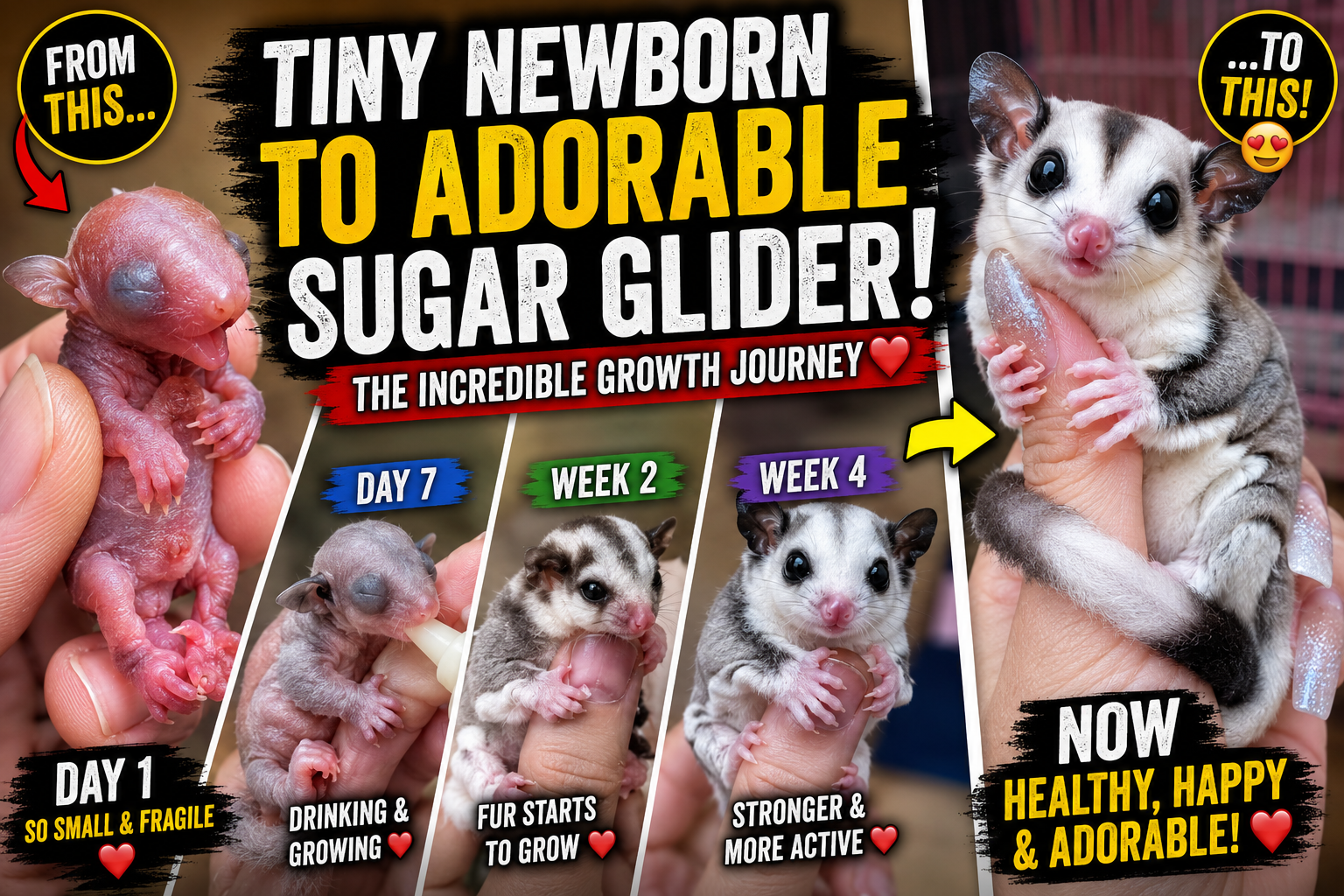
At the beginning of this heartwarming journey, the animal was almost impossibly small—a newborn sugar glider, so young and fragile that it could easily fit between a person’s fingers. With almost no fur, delicate pink skin, tiny limbs, and a body that had not yet developed, the little creature looked completely dependent on human care.
The earliest stage of its life was undoubtedly the most vulnerable. A newborn sugar glider cannot simply be treated like an ordinary pet. It requires warmth, careful feeding, protection, and constant attention. Every small detail matters because such a tiny body can quickly become weak if it does not receive enough nutrition or warmth.
A Tiny Life That Needed Constant Care
The first images show just how incredibly young the sugar glider was. Its body was almost entirely hairless, while its eyes and facial features were still developing. Its tiny paws and fingers were clearly visible, making it look more like a delicate newborn than the energetic animal it would eventually become.
At this stage, the caretaker had to handle the baby extremely gently. Feeding was done carefully and patiently, with a small amount of formula provided at a time. Because the animal was so tiny, feeding required precision and patience rather than simply giving it a large amount of food.
The goal was not only to provide nutrition but also to create a safe and comfortable environment where the baby could continue developing normally.
Day by Day, the Transformation Began
As the days and weeks passed, the tiny sugar glider slowly began to change.
One of the most remarkable signs of progress was the development of soft fur across its previously pink and almost hairless body. What initially looked like a fragile newborn gradually began to resemble the familiar appearance of a young sugar glider.
Its face became more defined, its ears became easier to see, and its eyes began to give it a much more alert and expressive appearance.
The transformation may seem small when viewed from one day to the next, but when the early and later stages are compared, the difference is extraordinary.
From a Fragile Baby to a Curious Little Animal
With continued care, the sugar glider became stronger and more active. Instead of simply lying helplessly in someone’s hands, it began to move around and interact with its surroundings.
Its tiny paws became more capable, allowing it to hold onto objects and explore. Its growing fur provided better protection, while its developing body gave it greater strength and mobility.
The animal also began to develop the adorable characteristics that make sugar gliders so fascinating. Its large dark eyes, small ears, soft white-and-gray fur, and tiny face gave it an increasingly recognizable appearance.
At one point, the caretaker could comfortably hold the young animal in the palm of a hand, showing just how much it had grown compared with its earliest stage.
A Remarkable Growth Journey
Perhaps the most touching part of the story is seeing the contrast between the newborn and the growing youngster.
At the beginning, there was a nearly hairless baby with an extremely delicate body.
Later, there was a small, furry animal with bright eyes and a much healthier appearance.
The journey demonstrates how much patience and consistent care can matter during the earliest stages of an animal’s life. Although the sugar glider remained very small, its development represented an enormous change from its fragile beginning.
Every feeding, every warm resting period, and every careful interaction contributed to helping the little animal reach the next stage of its development.
More Than Just a Cute Transformation
What makes this story so compelling is that it is not simply about watching a baby animal become cute and furry. It is about witnessing the gradual development of a life that began at an extremely vulnerable stage.
The caretaker’s role required patience and dedication. A newborn animal cannot explain when something is wrong, so its condition must be observed carefully. Changes in its appearance, energy, appetite, and movement can all provide important clues about its development.
Fortunately, the images show a remarkable transformation. The tiny newborn eventually became a much more recognizable and lively young sugar glider.
The Little Survivor Keeps Growing
By the later stage shown in the images, the sugar glider had developed a beautiful coat of fur and looked dramatically different from the newborn seen at the beginning.
Its eyes were open and expressive, its body had filled out, and it appeared far more alert and curious. Instead of looking like a fragile newborn, it now looked like a tiny animal ready to discover the world around it.
The journey from a nearly hairless newborn to a furry youngster is a powerful reminder of how quickly young animals can develop when they receive appropriate care.
What began as an incredibly tiny and vulnerable life gradually became a healthy-looking little sugar glider full of personality.
A Heartwarming Ending
The story of this little sugar glider is ultimately a story of growth, patience, and hope.
From the moment it was tiny enough to fit in a person’s fingers, every stage of development brought a new milestone. First came careful feeding and warmth. Then came the appearance of soft fur, followed by stronger movement, more developed features, and an increasingly curious personality.
The final images reveal just how far the little animal had come. Its transformation is almost unbelievable when compared with its earliest appearance.
From a fragile, nearly hairless newborn to a tiny, furry survivor, this sugar glider’s journey shows the incredible changes that can happen during the first stages of life when a vulnerable animal receives the care and attention it needs.