


A Tiny Life, a Broken Heart, and One Man’s Compassion
In a world where countless animals struggle to survive, sometimes a single act of kindness can make the difference between despair and hope. The story of a little baby monkey who appears to have lost its mother is a powerful reminder that compassion does not need words. It only needs someone willing to stop, care, and offer help when a helpless creature has nowhere else to turn.
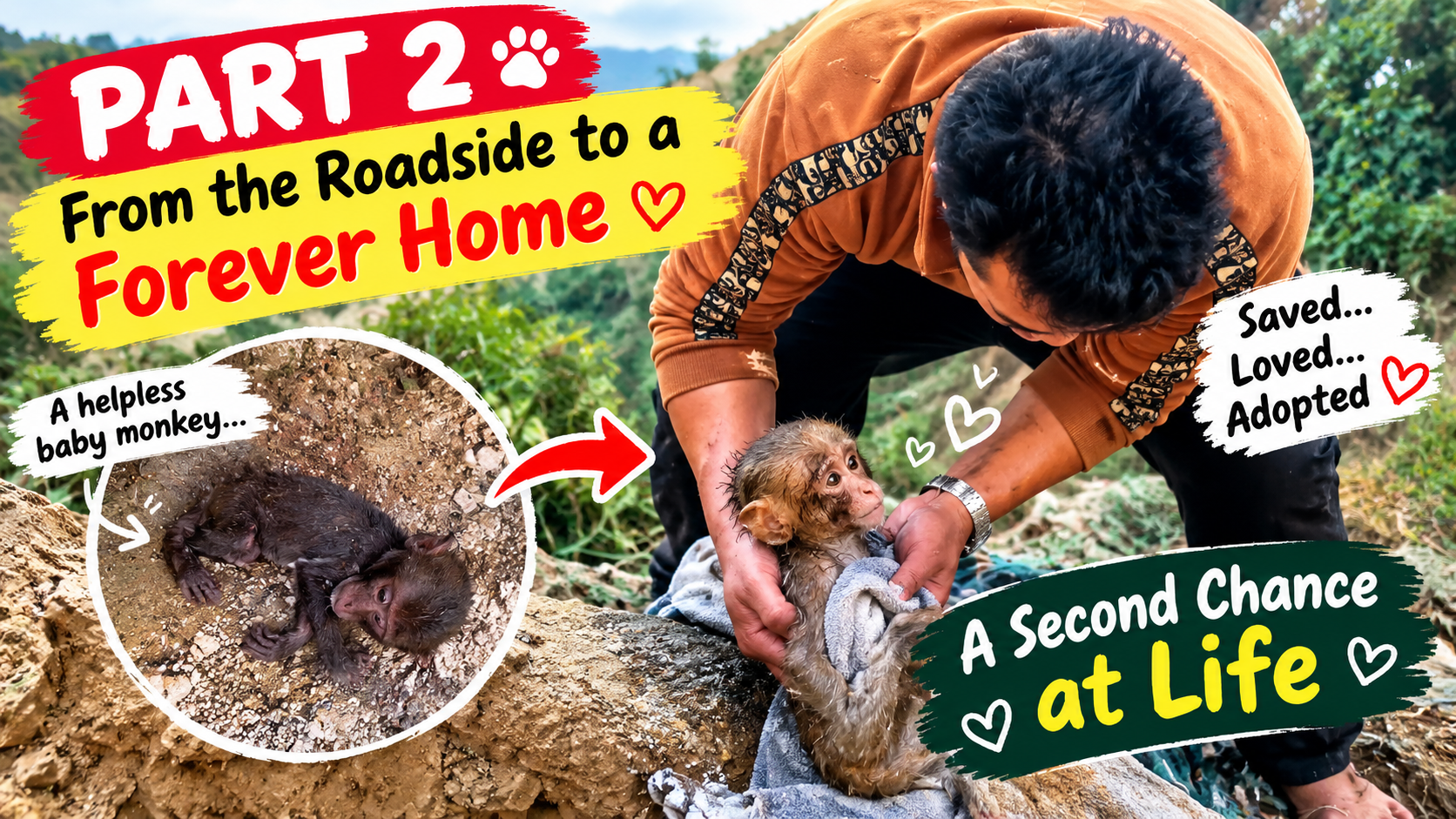
This emotional rescue story follows a vulnerable baby monkey whose circumstances appear heartbreaking. In the video, the tiny animal is shown being handled by a man in an outdoor area with rough, uneven ground. The on-screen captions describe the baby as having lost its mother and present the man as someone who takes the orphaned monkey into his care. Although the short clip does not establish every detail of the animal’s past, its central message is clear: a fragile young life deserves compassion, protection, and an opportunity to survive.
For a baby monkey, the world without its mother can be frightening. The familiar warmth, protection, and comfort that once surrounded it may suddenly be gone. Every unfamiliar sound, movement, and encounter can become a source of anxiety. Without dependable care, even ordinary challenges can become overwhelming.
Yet this story is not only about loss. It is also about the possibility of a new beginning.
1. The Painful Reality of an Orphaned Baby Monkey
The earliest stage of a young animal’s life is often the most vulnerable. Baby monkeys depend on their mothers for much more than nourishment. Their mothers provide warmth, security, protection, and opportunities to learn the behaviors necessary for survival.
A mother monkey also helps her infant understand its environment. Through close contact and observation, the baby gradually learns how to move, communicate, recognize danger, and interact with others. These early experiences are important foundations for its physical and social development.
When a baby loses its mother, those essential sources of support may disappear at once.
The little monkey featured in this story is presented as an orphan that has lost its mother. The exact circumstances surrounding the separation are not confirmed by the visible footage. We cannot determine whether the mother died, became separated from the infant, or was lost under other circumstances. Nevertheless, the situation described by the video highlights a genuine problem faced by vulnerable wildlife.
An orphaned infant cannot simply understand what has happened. It cannot explain its fear or ask a human for assistance. Its distress must instead be recognized through its behavior, physical condition, and immediate surroundings.
A young monkey left without appropriate care may face several dangers, including dehydration, inadequate nutrition, exposure to harsh weather, injury, and threats from other animals. Depending on its age and condition, it may also be unable to travel safely or find suitable food independently.
These challenges make timely intervention particularly important.
What makes this story emotionally powerful is the contrast between the baby’s vulnerability and the enormous difference that a caring person may be able to make. The animal is small, dependent, and unable to control its circumstances. The human who chooses to help, however, has the ability to seek assistance and create a safer environment.
Sometimes, that first decision to help is the beginning of an entirely different future.
2. A Difficult Moment in an Unforgiving Environment
The video shows a man bending down to handle the baby monkey in a rough outdoor setting. The surrounding ground appears dry and uneven, with exposed soil, rocks, and sparse vegetation. The scene gives the impression of an environment where a small, vulnerable animal could easily struggle to find safety.
For a baby monkey, unfamiliar surroundings can be especially intimidating.
Without its mother nearby, it may have no reliable source of reassurance. Even when people approach with good intentions, their presence can initially be frightening. Humans are much larger than a baby monkey, and being picked up or moved can create additional stress.
This is why rescuing a wild animal requires more than good intentions. It also requires patience, careful handling, and an understanding of the animal’s needs.
The man in the footage appears to be attending to the infant, but the brief visual sequence does not provide enough information to establish precisely how the rescue began or what condition the monkey was in before he arrived. We should therefore avoid assuming that every moment of the animal’s experience is shown.
What the scene does communicate is the importance of noticing a vulnerable creature rather than ignoring it.
An animal in distress cannot always attract attention in a way that humans immediately recognize. Sometimes, it is a passerby, a local resident, or someone who happens to encounter the animal who first realizes that something is wrong.
That person’s response can determine whether the animal receives assistance or remains exposed to danger.
In this case, the story focuses on a man who appears willing to take responsibility for the orphaned baby. Instead of treating the animal’s suffering as something unimportant, he becomes part of a possible path toward safety.
The moment is a reminder that compassion often begins with a simple action: stopping long enough to care.
3. The Man Who Chose to Help
The heart of this story is the decision to help a life that cannot repay the person offering assistance.
The man shown in the video is presented as someone who takes in the orphaned baby monkey. His actions form the emotional center of the rescue narrative, transforming a story about vulnerability into one about responsibility and hope.
Helping an orphaned wild animal can involve considerable challenges. The animal may be frightened, physically weak, or unfamiliar with human contact. It may also require specialized nutrition, careful monitoring, and veterinary assessment.
A person who encounters such an animal must consider its immediate safety while also recognizing that wildlife has needs that differ from those of domestic pets.
For example, a baby monkey should not automatically be given ordinary human food or treated as though it were a puppy or kitten. Its diet, temperature requirements, hydration, and social development depend on its species and age. Incorrect care can unintentionally cause harm, even when the caregiver is acting with kindness.
Professional wildlife rescuers and veterinarians can help determine what kind of support is necessary.
The footage does not establish whether the man is a trained wildlife rehabilitator or whether veterinary professionals were involved. It also does not confirm the precise arrangements made for the monkey’s long-term care. These details remain unknown.
Nevertheless, the story’s central message remains meaningful: a vulnerable animal deserves a response based on concern rather than indifference.
The man’s willingness to engage with the situation represents an important first step. By bringing attention to the baby’s needs, he creates the possibility that it can receive protection, appropriate care, and a chance to develop beyond the immediate crisis.
Sometimes, a rescue does not begin with a dramatic action. It begins when someone decides that a helpless creature matters.
4. Why a Mother’s Absence Changes Everything
To understand the emotional weight of this story, it helps to consider the relationship between a baby monkey and its mother.
For many primates, the mother-infant bond is central to early life. Young monkeys frequently remain close to their mothers, clinging to their bodies as they move through their surroundings. Physical contact offers warmth and reassurance, while the mother’s presence provides protection and opportunities for learning.
The relationship also helps infants develop confidence.
As a young monkey grows, it begins exploring its environment while remaining connected to its mother or other trusted members of its social group. It learns through observation, imitation, and interaction. These experiences gradually prepare it for greater independence.
An orphaned baby may lose access to these experiences at a critical stage.
Its difficulties are not necessarily limited to immediate physical survival. It may also require careful support to develop normal social behaviors. For some primate species, appropriate contact with other members of the same species is an important part of healthy development.
This is one reason why professional wildlife rehabilitation can be complicated. Keeping an infant alive is only part of the challenge. Caregivers must also consider its long-term welfare and future ability to live appropriately for its species.
A human caregiver may provide warmth, food, and protection, but humans cannot automatically replace every function performed by a mother monkey or a natural social group.
The baby’s story therefore raises an important question: what does meaningful rescue truly involve?
It is not simply about removing an animal from immediate danger. It is about understanding what the animal needs next, whether that means veterinary treatment, specialized rehabilitation, carefully managed social contact, or another appropriate form of professional care.
A successful rescue is measured not only by the moment an animal is picked up, but also by the quality of care it receives afterward.
5. From Fear Toward Safety
The emotional transition at the center of a rescue story is the movement from uncertainty toward the possibility of safety.
For a frightened infant, even a gentle approach may feel unfamiliar. It does not know whether the person approaching will protect it or pose a threat. It cannot understand human explanations, and it has no way to evaluate the rescuer’s intentions through language.
Trust, when it develops, must emerge through consistent and appropriate care.
A safe environment can reduce unnecessary stress by providing suitable shelter, quiet surroundings, and protection from hazards. A qualified caregiver can observe the animal’s behavior and physical condition while arranging any necessary veterinary assessment.
For a very young monkey, monitoring is particularly important because small changes in hydration, appetite, body temperature, or activity may signal a problem.
The visible video does not provide enough evidence to describe the baby’s medical condition or confirm a recovery. It would therefore be misleading to claim that the monkey was already healthy, that it received a particular treatment, or that it had completely overcome its difficulties.
Instead, the most responsible interpretation is that the rescue story introduces an animal in need and a person who appears to be offering assistance.
That beginning is significant in its own right.
Every rescue journey has an uncertain period between the discovery of an animal and the establishment of a safe, sustainable care plan. During that time, appropriate decisions can make a substantial difference.
For viewers, the scene encourages empathy while also highlighting the importance of informed action. If someone encounters an orphaned wild animal, the best response may be to contact a licensed wildlife rehabilitator or veterinarian rather than attempting to raise the animal independently.
Good intentions are most effective when they are supported by knowledge.
6. The Responsibility That Comes After Rescue
Rescuing a baby animal can be an emotional experience, but long-term care requires commitment that extends far beyond the initial moment.
If the man continues caring for the monkey, the infant’s needs would have to be considered at every stage of its development. Its age, species, health, and behavioral condition would influence the appropriate care plan.
Nutrition would be one important consideration. Young primates have specific dietary requirements, and feeding practices must be suitable for their developmental stage. Inappropriate foods or feeding methods can lead to serious complications.
Hydration would also matter. An animal that has experienced a period without adequate care may require careful assessment to determine whether it is dehydrated or otherwise unwell.
Veterinary evaluation could help identify injuries, illness, parasites, nutritional problems, or other concerns that are not obvious from a short video.
Equally important would be the monkey’s behavioral development.
Primates are intelligent, socially complex animals. Their needs extend beyond food and shelter. They may require opportunities for movement, exploration, appropriate enrichment, and social interaction suited to their species.
A household environment that appears comfortable to humans may not provide the space, stimulation, or specialized care required by a growing monkey. In addition, wildlife ownership and rehabilitation are regulated differently in different places, and keeping a wild primate may require authorization or may be prohibited altogether.
For these reasons, professional guidance is essential.
The video’s presentation of the man adopting the orphaned monkey should not be interpreted as proof that permanent private ownership is necessarily the best outcome. Depending on the animal’s circumstances, qualified rehabilitation or placement with an authorized facility may better serve its welfare.
The ultimate goal should be to protect the monkey’s health and future, not simply to create an emotional connection with it.
True compassion includes the willingness to seek expert help, follow appropriate regulations, and prioritize the animal’s needs even when doing so is difficult.
7. The Emotional Power of a Small Animal’s Story
Why do stories about rescued baby animals affect so many people?
Part of the answer lies in their vulnerability.
A young animal depends on others for almost everything. When that support disappears, its situation can feel painfully unfair. Viewers may imagine the fear and confusion it could experience and respond with a strong desire to see it protected.
The story of this baby monkey brings together several powerful themes: separation, uncertainty, kindness, and the possibility of a new beginning.
The loss described in the captions establishes the emotional context. The image of a man attending to the infant introduces a potential source of help. Together, these elements encourage viewers to consider what can happen when someone responds to vulnerability with compassion.
However, the most meaningful part of the story is not simply the sadness of an orphaned animal.
It is the recognition that suffering should lead us to thoughtful action.
Feeling sympathy for an animal is valuable, but sympathy becomes more effective when it encourages people to support reputable wildlife organizations, learn about responsible rescue practices, and respect the needs of wild species.
The story also reminds us that animals do not need to resemble humans to deserve consideration. A monkey cannot explain its circumstances, describe its emotions in words, or request assistance through familiar social conventions. Yet its inability to communicate in human language does not make its welfare less important.
We can acknowledge the uncertainty surrounding the baby’s history while still recognizing that vulnerable wildlife deserves careful attention.
That balance between empathy and responsible understanding is what gives an animal rescue story lasting significance.
8. The Difference Between Saving a Life and Telling a Story
Short videos often condense complicated events into a few emotionally powerful scenes. This format can introduce audiences to animal welfare issues, but it also has limitations.
A brief clip may show a rescuer handling an animal without revealing what happened before filming began. It may not explain whether the animal received professional treatment, where it was taken afterward, or how its long-term welfare was addressed.
The video in this case identifies the subject as an orphaned baby monkey and presents a man as taking the animal into his care. Those details establish the basic narrative, but they do not prove every possible claim about the rescue.
We do not know the monkey’s exact age, species, previous living conditions, medical status, or eventual outcome from the visible material alone.
Recognizing these limits does not weaken the story. It makes the account more trustworthy.
An effective animal rescue narrative can be emotionally engaging without inventing events. It can describe the vulnerability of the infant, the importance of timely assistance, and the responsibilities involved in wildlife rehabilitation while being honest about what remains unknown.
That approach respects both the animal and the audience.
It also avoids turning a real creature’s uncertain circumstances into an overly neat story in which every problem is instantly solved. In reality, rescue is often a process. Some animals recover quickly, while others need prolonged treatment and specialized care. Some can eventually return to an appropriate natural environment, while others require a different long-term arrangement.
The baby monkey’s future cannot be established from a single scene. What matters is that any intervention should be guided by its actual needs.
The most valuable rescue stories do more than generate emotion. They encourage people to think carefully about animal welfare and the responsibilities that follow when a human chooses to intervene.
9. A Second Chance Requires More Than Kindness Alone
The idea of a second chance is central to this story.
For the baby monkey, a second chance would mean more than being removed from an exposed or uncertain situation. It would mean receiving the support necessary to survive, develop, and experience a life suited to its needs.
That process may involve several stages.
First, the animal’s immediate condition must be assessed. If it is injured, weak, dehydrated, or ill, appropriate veterinary attention may be necessary.
Second, its basic needs must be met in a safe environment. Suitable temperature, nutrition, hydration, hygiene, and protection from hazards can be particularly important for a young animal.
Third, its behavioral and social development must be considered. The appropriate approach will depend on its species and developmental stage, and qualified professionals can help determine whether rehabilitation, managed social contact, or another arrangement is most suitable.
Finally, its long-term future must be planned responsibly.
For a wild primate, the best outcome is not necessarily permanent life as a household pet. A qualified wildlife rehabilitation program may be better equipped to support the animal’s development and determine whether eventual release is appropriate.
The video does not confirm that these steps occurred, but they illustrate what responsible care for an orphaned monkey may involve.
The man’s apparent willingness to help represents the beginning of the story, not necessarily its conclusion.
And that is an important distinction.
A rescue is not complete merely because the animal has been carried away from danger. The real measure of success is whether the animal receives the care and protection it needs over time.
Compassion opens the door. Knowledge, patience, and sustained responsibility help make a second chance possible.
10. What Viewers Can Learn From This Rescue
This story offers several lessons for anyone who cares about animals.
First, pay attention to vulnerable wildlife. An animal that appears alone may be orphaned, injured, or simply temporarily separated from its group. Its circumstances should be assessed carefully before anyone intervenes.
Second, avoid assuming that every apparently abandoned infant needs to be taken away immediately. In some wildlife situations, a parent may be nearby, and unnecessary interference can do more harm than good. If the animal is in immediate danger or clearly injured, contacting qualified professionals is often the safest approach.
Third, do not attempt specialized care without appropriate guidance. Wild primates have complex needs, and incorrect feeding, handling, or housing can create additional risks.
Fourth, support responsible wildlife rescue. Licensed rehabilitators, veterinarians, and reputable conservation organizations can provide expertise that an untrained person may not have.
Finally, remember that compassion includes respect for an animal’s natural behavior. The aim is not simply to make a wild animal comfortable around humans. It is to protect its welfare and provide the most appropriate future possible.
These lessons extend beyond monkeys. Birds, small mammals, reptiles, and other wild animals may also require careful intervention when they are injured or genuinely orphaned.
The right response depends on the species and circumstances, but the underlying principle remains the same: help should be guided by the animal’s needs rather than by emotion alone.
11. Hope for a Life That Cannot Speak for Itself
The image of a man bending down to attend to a tiny monkey captures a simple but powerful idea: a vulnerable life can become the focus of someone else’s concern.
The infant cannot explain its past. It cannot tell viewers what happened to its mother or describe the circumstances that brought it into the man’s care. The available footage leaves many questions unanswered.
Yet those unanswered questions do not prevent us from recognizing the importance of the situation.
A baby animal without dependable care may face serious challenges. Appropriate intervention can create opportunities for protection and recovery, provided that the response is suitable for its species and circumstances.
The man shown in the video becomes a symbol of that possibility. His apparent willingness to take responsibility gives the story its hopeful dimension.
We should not assume that the monkey’s journey will be easy or that its future is guaranteed. Wildlife rehabilitation can be demanding, and the needs of a growing primate can be complex. Its eventual outcome would depend on factors that the short video does not reveal.
But hope does not require certainty.
Sometimes, hope begins when a vulnerable creature is noticed. It grows when someone seeks help, makes careful decisions, and continues to put the animal’s welfare first.
For the baby monkey, the possibility of a better future lies not in a dramatic moment alone, but in the care that follows.
Conclusion: A Small Life Deserves a Future
Part 2 of this rescue story highlights the vulnerability of an orphaned baby monkey and the importance of compassionate, responsible intervention.
The video presents a heartbreaking situation: a young monkey described as having lost its mother, followed by a man who appears to take the infant into his care. Although the available footage does not establish every detail of the rescue or confirm the animal’s eventual recovery, it provides a meaningful starting point for reflecting on wildlife welfare.
The story reminds us that young animals depend on appropriate care during their most vulnerable stages. When that care is disrupted, the consequences can be serious. Timely assistance may offer a path toward safety, but long-term success requires more than a kind gesture. It requires patience, knowledge, professional guidance, and a commitment to the animal’s future.
The baby monkey’s story is therefore about both compassion and responsibility.
It asks viewers to look beyond the sadness of an orphaned animal and consider what meaningful help really means. It reminds us that wild animals have complex needs, that their welfare should come before our desire to keep them close, and that trained professionals can play an essential role in their recovery.
Above all, it shows why small acts of concern matter.
A single encounter cannot erase the difficulties an animal has experienced. Nor can we know from a short video what the future will hold. But when someone responds thoughtfully to a vulnerable life, the possibility of a better outcome begins to emerge.
The little monkey deserves more than sympathy. It deserves safe, appropriate care and the opportunity to grow under conditions that support its welfare.
And perhaps that is the most important message of all: the true meaning of rescue is not simply taking an animal out of danger. It is giving that animal the best possible chance to live.