

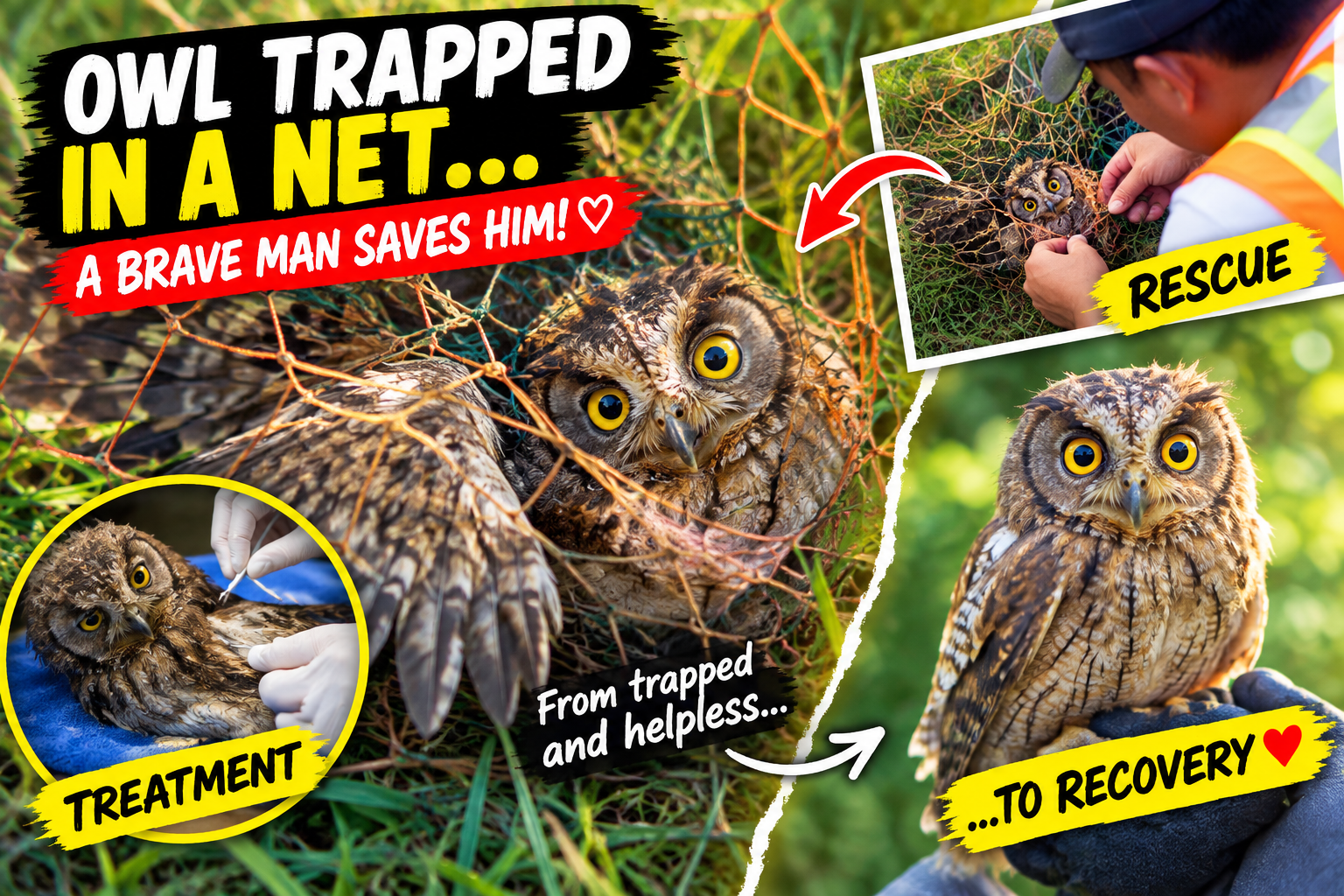
It was an ordinary day when a man noticed something unusual in a grassy area. As he approached, he discovered a frightened owl hanging helplessly from a large net. The bird had somehow become tangled in the mesh, leaving its wings and body trapped and making it almost impossible for it to escape on its own.
The owl appeared exhausted and terrified. Every attempt to move only caused the net to tighten around its body, putting the bird at risk of further injury. Realizing that the owl could not free itself, the man immediately stepped in to help.
🕸️ A Dangerous Situation
The net had wrapped tightly around the owl, particularly around its wings and body. The bird struggled to keep itself balanced while hanging close to the ground.
The rescuer carefully approached rather than pulling the owl away suddenly. Because an owl’s wings and feathers are extremely delicate, cutting or removing the net too aggressively could cause additional injuries.
He began working slowly to loosen the strands, trying to keep the owl as calm as possible throughout the rescue.
❤️ Carefully Freeing the Owl
After patiently working through the tangled sections, the man was finally able to release the owl from the net.
Although the bird was free, the rescue was not over. The owl had spent an unknown amount of time trapped and was visibly stressed and exhausted. The man therefore continued to monitor it instead of immediately leaving it alone.
He carefully checked the bird for possible injuries caused by the net and made sure it had a safe, quiet place to recover.
🩹 Treatment and Recovery
The owl’s condition required gentle care after the traumatic experience. Any cuts, pressure injuries, or damage to the wings and feathers would need attention before the bird could safely return to the wild.
The rescuer focused on keeping the bird calm and allowing it to regain its strength. With appropriate treatment, hydration, nutrition, and rest, the owl could gradually recover from the ordeal.
What began as a frightening situation slowly turned into a hopeful recovery.
🦉 A Second Chance
The most emotional part of the story is that the owl was not abandoned when it became trapped. A passerby noticed the struggling bird and chose to stop and help.
The rescue required patience and care, but eventually the owl was given a second chance. Its story is a reminder that discarded nets and other human-made materials can become dangerous traps for wildlife.
For this owl, one person’s decision to stop and help may have made the difference between life and death. What looked like a helpless bird trapped in a net became a remarkable story of rescue, treatment, and hope for a return to freedom.