


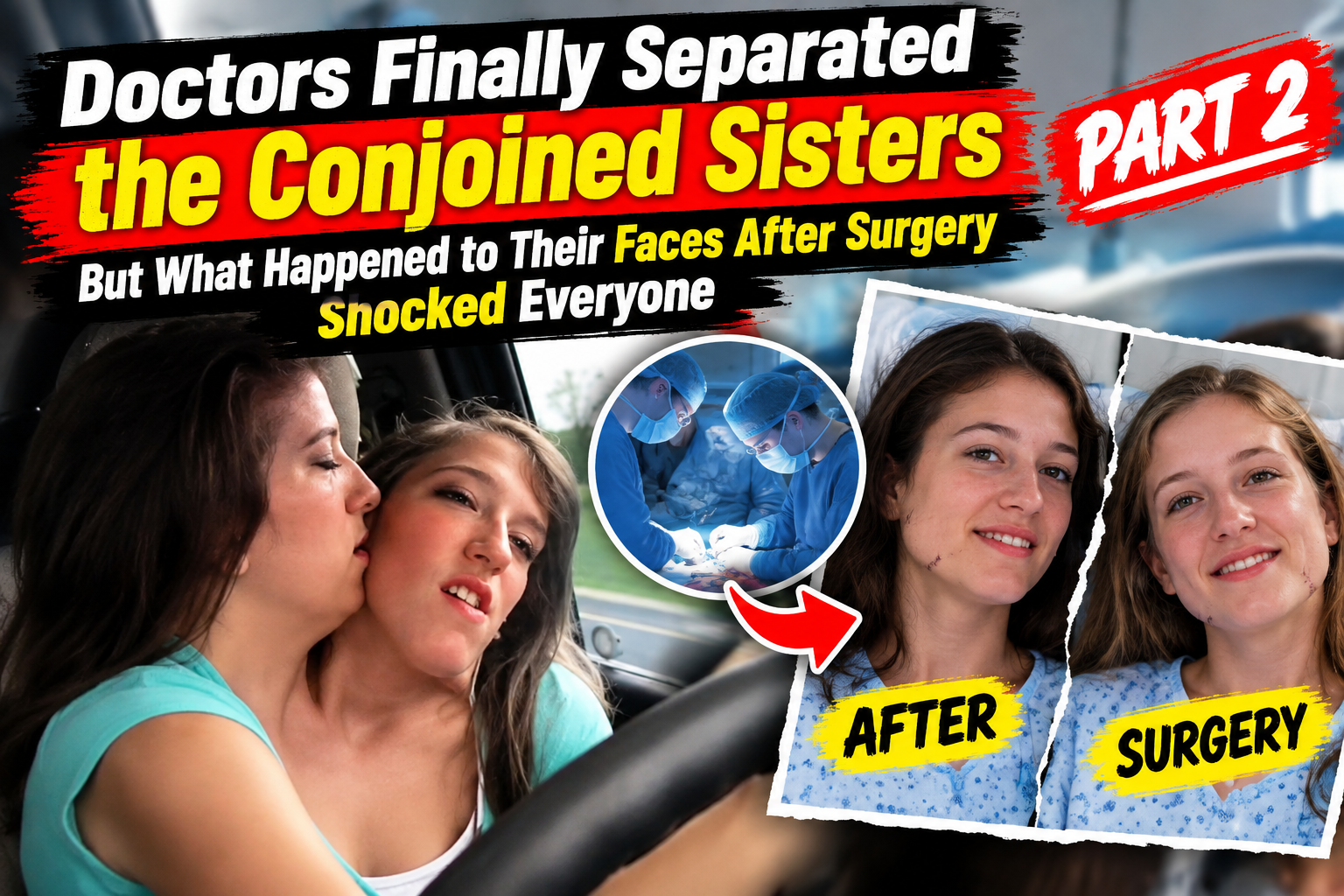
For most of their lives, the two sisters had known something that very few people could ever understand.
They were never truly alone.
Every morning, they woke up together. They moved together. They ate together. They laughed together. Even the simplest things that other children could do without thinking required them to cooperate.
Their lives were connected in a way that went far beyond an ordinary sibling relationship.
They were conjoined sisters.
And as they grew older, one question became impossible to ignore:
Could they ever live as two separate people?
A Decision That Could Change Everything
As children, the sisters had learned how to adapt to their unusual circumstances.
They developed their own rhythm.
One would move slightly, and the other would instinctively understand what she wanted. They learned to coordinate their movements and help each other through everyday activities.
To outsiders, their situation seemed impossible.
But to the sisters, it was simply life.
They knew no other way.
However, as they became older, doctors began discussing a possibility that would completely change their future.
A separation surgery.
It sounded like a miracle.
But it was also one of the most frightening decisions their family had ever faced.
Because separating conjoined twins is not simply a matter of separating two bodies.
In some cases, the twins can share blood vessels, nerves, tissue and other vital structures.
One wrong decision could have devastating consequences.
The Doctors Faced an Extraordinary Challenge
Before surgery could even be considered, the medical team needed to understand exactly how the sisters were connected.
Doctors performed detailed examinations and studied their anatomy carefully.
Every millimeter mattered.
The team had to determine where one sister’s body ended and the other’s began.
They also had to consider how the separation might affect their appearance afterward.
The face was especially complicated.
The sisters had spent years with their bodies positioned closely together, and separating them could leave significant differences in the shape and structure of their faces.
There was no guarantee that both sisters would come out looking exactly as everyone hoped.
There was also no guarantee that the reconstruction would be successful on the first attempt.
The risks were extremely high.
Their Family Had to Make an Impossible Choice
For the family, this was not simply a medical procedure.
It was a decision between two frightening possibilities.
If they remained together, the sisters could continue living the life they had always known.
But they might face increasing physical difficulties as they grew older.
If doctors attempted to separate them, they could potentially gain independence.
But the surgery itself could put their lives at risk.
Imagine being asked to make that decision for two children you love more than anything.
There was no easy answer.
Eventually, after extensive consultations, the family and medical team decided to move forward.
The sisters would undergo the operation.
The Day of the Surgery
On the morning of the operation, the atmosphere was completely different.
The sisters were taken into the hospital while their family waited outside.
Behind the operating-room doors, an entire team of specialists prepared for the procedure.
Surgeons.
Anesthesiologists.
Nurses.
Reconstructive specialists.
Everyone had a specific responsibility.
There was no room for improvisation.
The operation would require patience, precision and constant monitoring.
Hours passed.
Then more hours.
Outside the operating room, every minute felt longer than the one before.
Their family could only wait.
The Moment They Were Finally Separated
Eventually, after an extraordinarily difficult procedure, the doctors reached the moment everyone had been waiting for.
The sisters were finally separated.
For the first time in their lives, there was space between them.
Two bodies.
Two beds.
Two individual lives.
But the medical battle was not over.
In fact, another major challenge was just beginning.
Their Faces Had Changed
After separation, the sisters needed extensive reconstruction and recovery.
Their faces did not simply look the way they had before.
The separation had changed the appearance of the tissue around the areas where their bodies had been connected.
Doctors now had to work carefully to restore as much natural structure as possible.
This was where the emotional side of the surgery became especially difficult.
The sisters had spent their entire lives seeing each other constantly.
Now, for the first time, they were able to look at themselves individually.
The changes were difficult to process.
One Sister Looked at the Other
When the sisters were eventually able to see each other again, the moment was deeply emotional.
They were no longer physically connected.
But their bond had not disappeared.
If anything, it seemed stronger.
They had survived something that very few people could understand.
The scars and changes on their faces were reminders of the enormous journey they had just experienced.
But beneath those changes were the same two sisters who had grown up together.
They still smiled at each other.
They still recognized each other.
And they still understood what the other was feeling without needing many words.
Recovery Was Harder Than Anyone Expected
The operation may have ended, but recovery required enormous patience.
The sisters had to learn how to move differently.
They had to adjust to having their own physical space.
Even simple movements that most people take for granted suddenly became new experiences.
There were moments of discomfort.
There were moments of fear.
And there were moments when they simply wanted everything to go back to the way it had been.
But every day brought another small achievement.
Sitting independently.
Moving independently.
Looking into a mirror.
Smiling.
Talking.
Learning to live as individuals.
Each milestone represented something much bigger than physical recovery.
It represented freedom.
The Mirror Became a Symbol of Their New Lives
For years, the sisters had looked at each other and seen a reflection of their shared existence.
After the operation, the mirror meant something different.
Each sister could finally see herself as an individual.
The changes to their faces were noticeable.
There were scars.
There were differences.
There were reminders of the surgery.
But there was also something new.
Identity.
For the first time, each sister could begin asking herself a question that had never been fully possible before:
“Who am I?”
Their Separation Did Not Separate Their Hearts
Perhaps the most beautiful part of the story was that becoming physically separate did not mean becoming emotionally distant.
They remained sisters.
The years they spent together had created a connection that surgery could never remove.
They still supported each other.
They still laughed together.
And they still understood one another in a way that nobody else could.
The operation changed their bodies.
It did not change their bond.
A New Life, One Step at a Time
The sisters’ story is not simply about a dramatic medical operation.
It is about courage.
It is about family.
And it is about two people facing an extraordinary challenge together.
Their faces after surgery may have looked different.
Their bodies may have carried scars.
Their lives may have entered an entirely new chapter.
But none of those changes could erase what they had been through.
They had spent years connected physically.
Now they had the chance to discover what independence felt like.
And perhaps the most powerful lesson was this:
Being separated did not mean losing each other.
It meant finally having the freedom to become two individuals while remaining sisters forever.
The surgery changed the way the world saw them.
But their love for one another remained exactly the same.
And for two sisters who had spent their entire lives together, that may have been the most important transformation of all.