

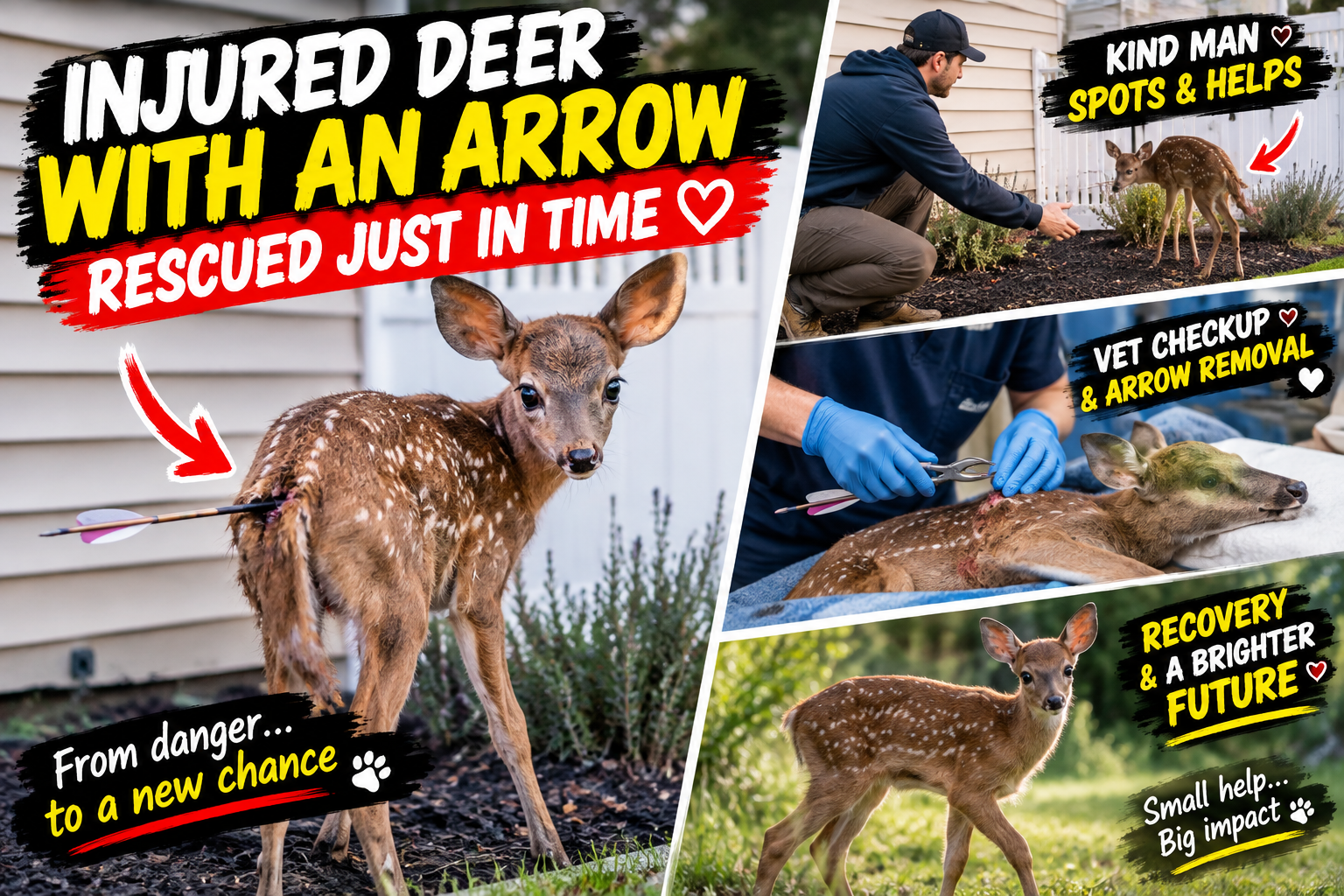
The heartbreaking rescue began when a small deer was spotted near a residential area with an arrow visibly sticking from the side of its body. The young animal appeared frightened and confused, standing close to a house while trying to move normally despite the object lodged near its hip.
The situation suggested that the deer had been struck by an arrow during a hunting incident. Instead of remaining in the wilderness, the injured animal had wandered into a residential area, likely searching for somewhere safe. The arrow was clearly visible, making it obvious that the deer needed professional help.
A Dangerous Injury
For a young deer, an arrow embedded in the body can be extremely serious. Even when there is no obvious external bleeding, an embedded projectile can cause damage to muscles, blood vessels, or internal structures. Moving the animal unnecessarily could potentially make the injury worse.
Fortunately, a compassionate man noticed the injured deer and decided to help. He approached cautiously because frightened wildlife can react unpredictably when injured. Rather than attempting to pull the arrow out himself, the safest approach was to contact trained wildlife rescuers or a veterinarian.
The Rescue
Wildlife professionals were brought in to safely handle the deer. The animal needed to be restrained carefully so that it would not injure itself while the arrow was being examined and removed.
The rescuers first assessed the location and condition of the wound. They would also determine whether the arrow had penetrated deeply or damaged any important structures. Once the deer was safely stabilized, the arrow could be removed using appropriate veterinary techniques.
The process required patience and precision. The goal was not simply to remove the visible object, but to make sure the deer was not suffering from additional internal injuries.
Treatment and Rehabilitation
After the arrow was removed, the wound could be cleaned and treated by veterinary professionals. Depending on the extent of the injury, the deer might require medication to control pain and prevent infection, along with fluids, rest, and careful monitoring.
Because the deer was young and had already experienced significant stress, rehabilitation would focus on allowing it to regain strength in a quiet, secure environment. Its ability to walk normally, eat, drink, and respond to its surroundings would be monitored throughout recovery.
If the injury healed successfully and the deer regained sufficient strength to survive independently, the ultimate goal would be to return it to the wild.
A Young Life Given Another Chance
Seeing such a young deer wandering around with an arrow lodged in its body is a heartbreaking reminder of the dangers wildlife can encounter. Fortunately, someone noticed that the animal was in trouble and took action instead of simply walking away.
From being frightened and injured near a home to receiving professional attention and a chance to recover, the deer’s story is ultimately one of compassion and hope.
One person’s decision to stop and help gave this young deer a chance to heal—and potentially return to the wild where it belongs.