


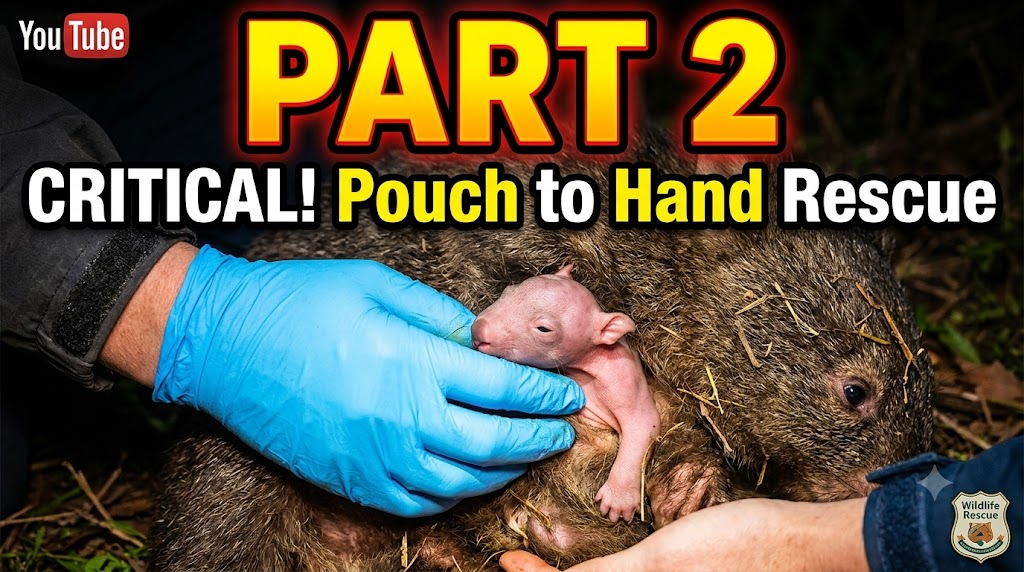
The rescue began when wildlife rescuers encountered a heartbreaking and unusual situation involving a mother wombat and her tiny baby. From the images, the animal appears to be a wombat, not a bear. A small newborn was visibly protruding from the mother’s pouch area, creating an alarming situation that required careful intervention.
The tiny wombat was extremely vulnerable. At such a young age, it would normally depend heavily on its mother for warmth, protection, and nourishment. Seeing the baby partially outside the pouch raised concerns that it could become separated from its mother or suffer an injury if it remained in an unsafe position.
A Delicate Rescue
Wildlife rescuers approached the mother and baby carefully. Because wombats are wild animals and the mother could become frightened or defensive, every movement needed to be controlled and gentle.
The rescuers examined the baby to determine how it was positioned and whether it was trapped. Rather than pulling forcefully, they carefully supported the tiny animal and worked to free it while minimizing stress to both the mother and her young.
In the second image, the rescuers can be seen wearing protective gloves while carefully handling the baby wombat. Their priority was to safely separate and reposition the baby without causing additional injury.
Care After the Rescue
Once the baby was safely removed from the difficult position, it needed warmth, protection, and close monitoring. A newborn wombat is highly dependent on specialized care, so wildlife professionals would assess its breathing, body temperature, hydration, and overall condition.
The rescuers would also examine the mother for injuries and determine whether the baby could safely remain with her. If reunification was possible, keeping the young wombat with its mother would generally be an important part of its recovery because the mother provides natural warmth, protection, and nourishment.
If the baby could not immediately return to its mother, wildlife rehabilitators could provide temporary supportive care until it was strong enough to be reunited or continue rehabilitation.
A Fragile Life Given a Chance
The situation shows just how vulnerable newborn wildlife can be. A tiny baby wombat that appeared to be in an unusual and potentially dangerous position received help from people who understood that it needed to be handled with extreme care.
From the moment rescuers discovered the baby emerging from its mother to the careful examination and hands-on assistance, every step was focused on protecting the fragile animal.
What looked like a frightening situation became a hopeful rescue, giving this tiny wombat a chance to remain safe, recover, and continue growing under proper wildlife care.