


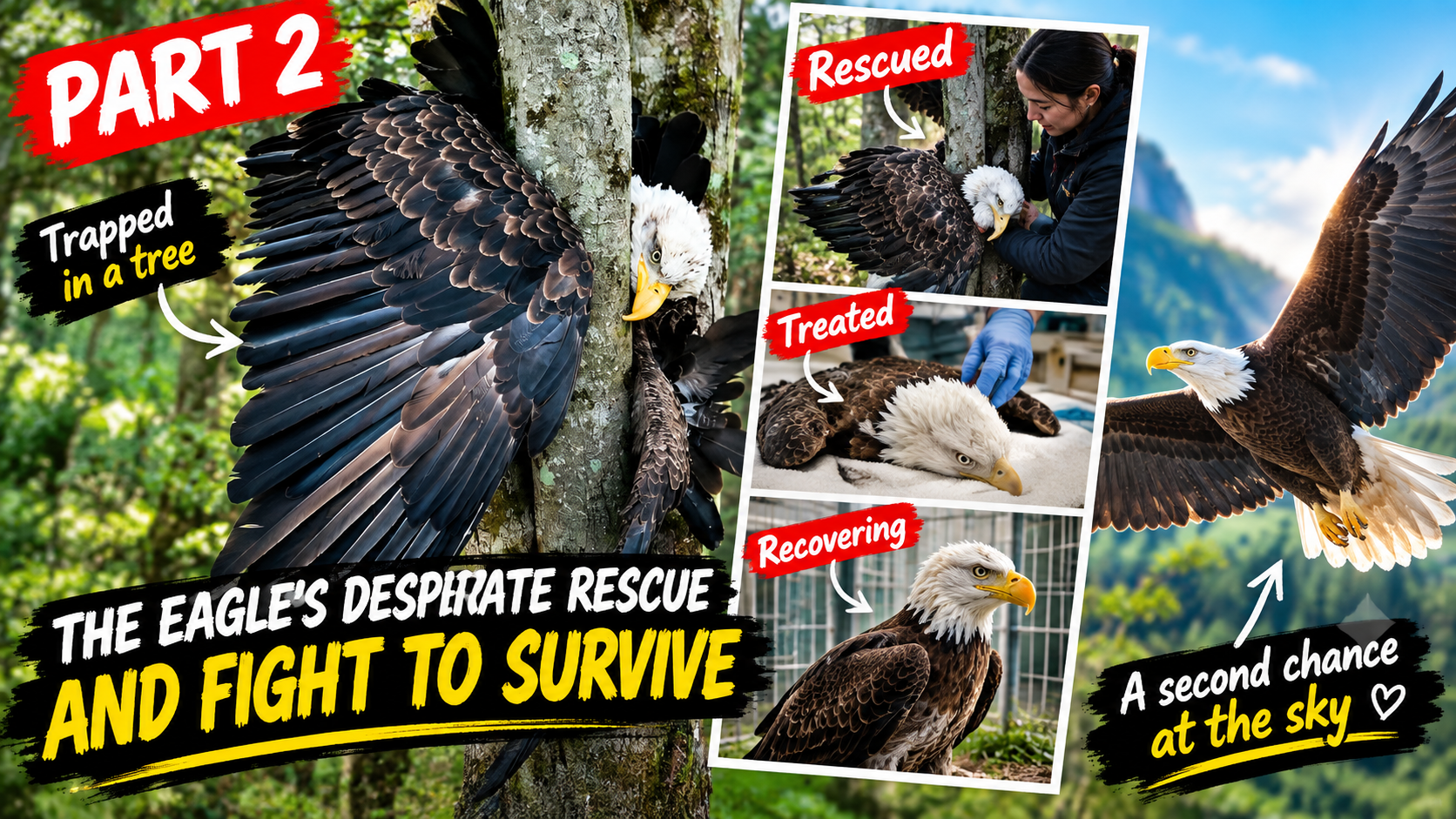
Deep inside the forest, a heartbreaking scene unfolded when rescuers discovered an injured bald eagle trapped against the trunk of a tree. Its enormous wings were spread awkwardly around the tree, while its body appeared exhausted and unable to free itself.
The magnificent bird that normally belongs in the open sky was now completely helpless.
The Eagle Was Trapped
When the rescuers first came across the eagle, it was wedged against the tree trunk with its wings tangled around the branches and surrounding vegetation. The bird appeared extremely weak, frightened and exhausted.
Its feathers were spread across the tree, and it could barely move without making the situation worse.
For an animal that depends on powerful wings for survival, being unable to fly is incredibly dangerous. The longer it remained trapped, the more vulnerable it became to dehydration, exhaustion and further injury.
The rescuers knew they had to act carefully.
A Dangerous Rescue
A woman approached the eagle and began working to free it.
This was not something that could simply be rushed. A frightened eagle can injure itself or the person attempting to help it, especially when its wings and talons are involved.
The rescuers therefore concentrated on keeping the bird as calm as possible while carefully working around its body and wings.
Little by little, they released the eagle from the tree.
After what must have been an extremely stressful ordeal, the bird was finally free.
The Eagle Needed Immediate Care
Being freed from the tree was only the beginning.
The eagle was clearly exhausted and needed somewhere safe to recover. Instead of immediately releasing it back into the forest, the rescuers brought it into care so its condition could be assessed.
The bird needed time to rest after the traumatic experience.
Wildlife professionals could then examine its wings, body and feathers for injuries and determine whether it was strong enough to survive independently.
The Recovery Process
During rehabilitation, the focus was on giving the eagle a quiet and protected environment where it could regain its strength.
It was monitored closely and given appropriate food and care while its condition improved.
Its wings were particularly important. For a bald eagle, the ability to fly is essential not only for movement but also for finding food, escaping predators and returning to its natural habitat.
The goal was therefore not simply to keep the bird alive — it was to help it become strong enough to function normally in the wild again.
From Helpless to Strong Again
As the eagle recovered, its condition gradually improved.
The frightened bird that had once been trapped against a tree began to regain its energy. Its beautiful feathers could once again be seen clearly, and its powerful wings became a symbol of the strength it was slowly recovering.
Every day of rehabilitation brought it one step closer to freedom.
The transformation was especially meaningful because the eagle had been found at a moment when it could not save itself.
Someone had to notice it.
Someone had to stop.
And someone had to take the risk of helping.
A Second Chance in the Wild
Eventually, the hope for the eagle was simple: return it to the sky.
After receiving the necessary care and becoming strong enough to survive independently, a rehabilitated eagle can potentially be returned to its natural environment.
The story is a powerful reminder that even an animal as large and powerful as a bald eagle can become completely vulnerable when injured or trapped.
What began with an exhausted bird clinging helplessly to a tree became a story of compassion, patience and recovery.