


The most disturbing part of this case may not have been the initial confrontation. It was what happened after the phone call to 911.
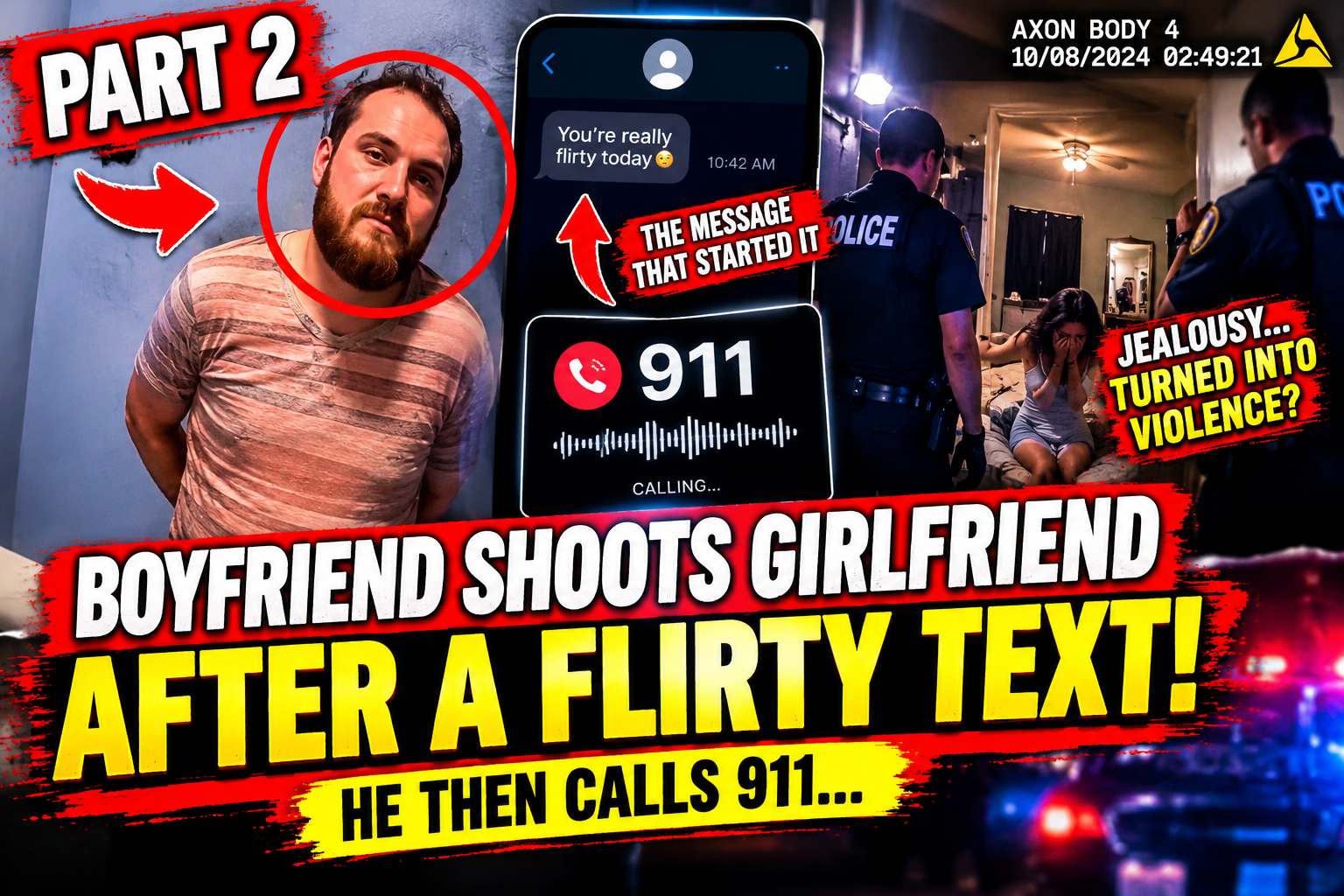
According to the headline accompanying the footage, a boyfriend allegedly shot his girlfriend following a flirtatious text message and then contacted emergency services himself. The image shows the man later in police custody, appearing to be questioned after the incident.
But Part 2 begins with a different question:
What happens when the person responsible for a violent incident is the one who calls police and tells them what happened?
The 911 Call Changes Everything
When officers receive a call involving a shooting, every second matters.
Dispatchers need to determine where the incident occurred, whether anyone is injured, whether the suspect is still present, and whether there is an immediate threat to responding officers or other people.
In this case, the video’s description claims that the boyfriend contacted 911 himself.
That detail immediately creates a complicated situation.
A person who voluntarily calls emergency services may provide important information about what happened, but investigators still have to independently verify the story.
They cannot simply accept one person’s version of events.
The scene itself must be examined.
Witnesses may need to be interviewed.
Evidence has to be documented.
And the timeline has to make sense.
The Man in Custody
The bodycam-style footage shown in the screenshot presents the man after police intervention.
He appears to be inside a room with his hands behind his back, suggesting that officers have already taken control of the situation.
At this stage, the dramatic confrontation may be over.
But for investigators, the real work is only beginning.
Police now need to determine exactly what happened before the 911 call.
What happened between the couple?
What was contained in the message that allegedly triggered the confrontation?
What happened immediately before the shooting?
And why did the man decide to contact emergency services afterward?
Those questions become central to the investigation.
A Text Message Becomes the Focus
The video’s headline places a flirtatious text message at the center of the alleged dispute.
But a message on a phone does not, by itself, explain an entire incident.
Investigators would need to establish the context surrounding the communication, who sent it, when it was sent, and how the people involved interpreted it.
Digital evidence can potentially help establish a timeline, but the screenshot does not provide enough information to determine what the actual message contained or what investigators ultimately concluded about it.
That distinction matters.
A dramatic headline can summarize an allegation, while the underlying investigation may reveal a much more complicated sequence of events.
Police Begin Reconstructing the Timeline
Once officers have secured the scene, they can begin working backward.
The goal is to understand what happened before, during, and after the reported shooting.
Investigators may need to compare statements with physical evidence and establish the sequence of events minute by minute.
The 911 call could become particularly important because it may provide information about what the caller reported immediately after the incident.
But investigators still have to determine whether the account is consistent with the evidence.
That is where the case can become much more complicated.
The Difference Between an Admission and the Full Story
A person calling police and admitting involvement does not necessarily answer every question surrounding a case.
Investigators still need to establish the circumstances.
They need to determine what happened, who was involved, and whether the evidence supports the account given by the person in custody.
This is why the aftermath of an incident can sometimes be just as important as the initial emergency response.
The first version of the story is only the starting point.
The evidence has to tell the rest.
What Was Going Through His Mind?
The headline suggests that the alleged shooting was connected to jealousy over a text message.
However, it would be inappropriate to speculate about the person’s thoughts or motives beyond what has been officially documented.
What viewers can see is a man who has been taken into custody following an incident described as a shooting.
The emotional circumstances surrounding the relationship may be relevant to understanding the case, but they should be distinguished from facts established by investigators or a court.
The Investigation Gets Bigger
After the immediate danger has passed, investigators may have to examine the entire relationship and the circumstances surrounding the incident.
They may need to identify witnesses, collect relevant digital evidence, document the scene, and establish a reliable timeline.
Meanwhile, the victim’s condition and the medical response would become critical parts of the case.
The screenshot itself does not establish the victim’s medical outcome, so that detail should not be assumed.
The Question Nobody Can Ignore
The most important question surrounding Part 2 is not simply why a text message was sent.
It is what happened afterward.
A message can start an argument.
An argument can escalate.
But the events that allegedly followed became serious enough for police and emergency responders to become involved.
That is the point where a relationship dispute reportedly turned into a criminal investigation.
The 911 Call May Become a Critical Piece of Evidence
If the video’s description is accurate that the boyfriend called 911 himself, the call could become an important part of the investigative timeline.
Dispatch recordings can potentially establish what the caller said, when he called, what information he provided, and how officers were instructed to respond.
Investigators could then compare those statements with evidence recovered at the scene.
If the accounts match, they become part of the broader evidentiary picture.
If they don’t, investigators have another inconsistency to examine.
Part 2: The Story Is Far From Over
By the time the bodycam footage shows the man in custody, the immediate confrontation appears to have ended.
But that doesn’t mean the story is finished.
Now comes the difficult part:
reconstructing exactly what happened.
The text message.
The argument.
The alleged shooting.
The 911 call.
The police response.
And the evidence left behind.
Each piece has to fit into the same timeline.
PART 2 — AFTER THE 911 CALL
A relationship argument reportedly begins with a message.
The situation allegedly escalates into a shooting.
Then, instead of disappearing, the boyfriend reportedly calls 911 himself.
When officers arrive, they take control of the scene and place him in custody.
But the biggest questions remain:
What exactly happened between the text message and the shooting? What did he tell the dispatcher? And does the evidence support the story he gave police?
Part 2 isn’t just about the arrest. It’s about what investigators discover after the initial confession — when every message, statement, and piece of evidence has to be examined to determine what really happened.